Engineering Leadership in the Age of AI: Managing Software Teams When AI Writes Code

A few years ago, improving an engineering team was straightforward in theory: hire strong people, give them clear problems, remove blockers, ship consistently. Today, I regularly see a single developer produce in a day what used to take several people a week — with AI assistance doing a significant portion of the heavy lifting.
At first, this feels like a superpower. Then the second-order effects start showing up.
Code volume goes up. Confidence goes up. But clarity, ownership, and sometimes even quality can quietly go down if leadership doesn’t adapt. What surprised me most is that AI didn’t just change how engineers work — it changed where leadership attention is needed.
Here are the shifts I’ve personally found most important.
The Bottleneck Moved — From Typing Code to Thinking Clearly
In teams I’ve worked with, coding itself is no longer the slowest step. The hardest part now is defining the problem precisely enough that both humans and machines produce the right solution.
I’ve seen engineers generate large amounts of “working” code quickly, only to realize later that it solved the wrong problem or created architectural friction. AI is excellent at answering the question you ask — even when that question is poorly framed.
Strong engineers have become dramatically more effective because they know what to ask for and what to ignore. Less experienced engineers can produce impressive output that still requires heavy correction.
As a leader, I now spend more time ensuring the team understands the problem deeply than worrying about whether they can implement the solution.
My Job Shifted From Tracking Work to Shaping Decisions
Earlier in my career, a lot of management energy went into coordination: sprint planning, task breakdown, progress tracking. Those activities still exist, but they matter less than the decisions that happen before any code is written.
Today, the biggest risks come from:
- Choosing the wrong approach quickly
- Introducing fragile solutions at scale
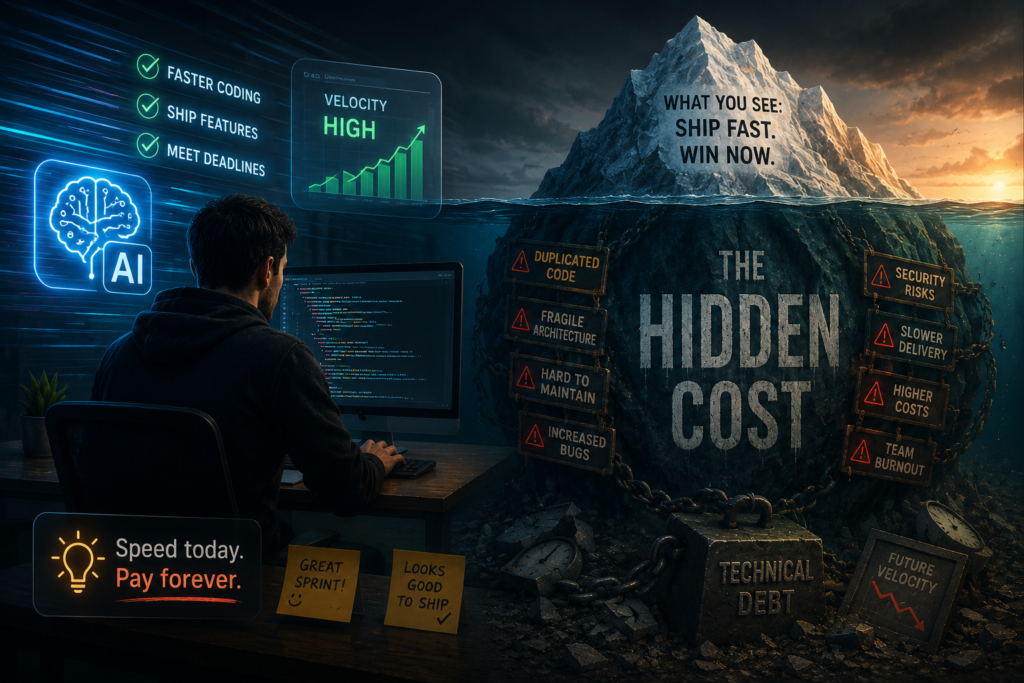
- Accumulating invisible technical debt
- Over-relying on tools without understanding their limits
I’ve found myself reviewing designs earlier, asking more “why” questions, and pushing for clarity before execution begins. When implementation is fast, mistakes are fast too — and they compound.
Leadership has become less about managing effort and more about governing direction.
Speed Created a New Kind of Fragility
One pattern I didn’t anticipate was how speed can hide problems. When teams move slowly, issues surface naturally. When they move very fast, issues accumulate until they suddenly become visible.
For example, I’ve seen situations where:
- Codebases grew rapidly but consistency degraded
- Multiple AI-generated patterns coexisted without cohesion
- Documentation lagged far behind implementation
- Knowledge stayed with individuals instead of the team
None of these are new problems, but AI amplifies them.
I now pay closer attention to system coherence than raw delivery speed. Shipping quickly is valuable only if the system remains understandable six months later.
Senior Engineers Are Getting Stronger — Juniors Need More Support
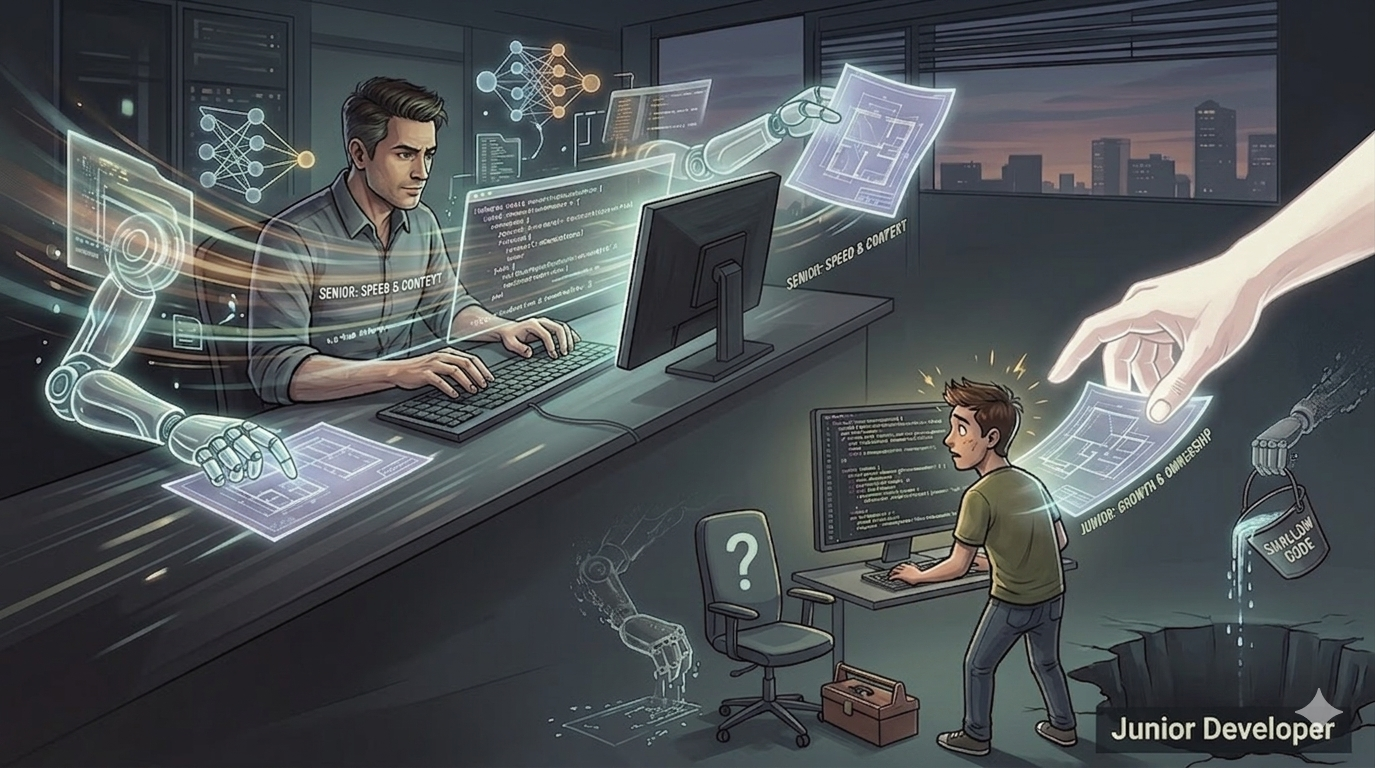
One of the clearest trends I’ve observed is that experienced engineers benefit disproportionately from AI tools. They use them to accelerate thinking, explore alternatives, and automate routine work while maintaining control over quality.
Less experienced engineers sometimes struggle to evaluate outputs critically. When everything “looks correct,” it can be hard to know when something is subtly wrong.
This has implications for hiring and mentoring. Growing talent now requires deliberate effort to ensure fundamentals aren’t skipped. I’ve started encouraging engineers to explain generated solutions in their own words — not as a test, but as a way to build understanding.
AI can accelerate learning, but only if used intentionally.
Architecture Matters More Than Ever
When implementation becomes cheap, architecture becomes expensive to get wrong.
I’ve noticed that AI-generated components can introduce inconsistencies in patterns, error handling, or performance assumptions. Individually they work; collectively they may not.
This has pushed me to emphasize:
- Clear architectural principles
- Shared conventions
- Early design reviews
- Long-term maintainability over short-term convenience
Another challenge is that systems incorporating AI services behave differently from traditional software. Outputs may vary, dependencies may change outside your control, and debugging can involve probabilities rather than certainties.
Leaders need to account for these realities when planning systems, not just features.
Traditional Metrics Started Feeling Hollow
At some point, I realized that many metrics we relied on were becoming less meaningful. Velocity can increase simply because tools are doing more of the work. Lines of code say even less than before.
What matters more — and what I pay attention to now — includes:
- Are we solving the right problems?
- Is the system becoming easier or harder to evolve?
- Are incidents decreasing or increasing?
- Do engineers understand what they’re shipping?
- Is the business seeing measurable impact?
Output is easy to inflate. Outcomes are not.
Leadership Is Becoming About Capability, Not Control
Perhaps the biggest shift is philosophical. I no longer think of leadership primarily as directing a team’s work. It feels more like shaping an environment where good decisions happen consistently.
That includes:
- Building a culture of verification, not blind trust
- Encouraging thoughtful use of tools rather than blanket adoption
- Preserving institutional knowledge
- Ensuring engineers grow, not just produce
- Balancing speed with sustainability
In many ways, the role is moving from managing people to designing a resilient system — one that includes humans, processes, and increasingly powerful tools.
Closing Thoughts
AI hasn’t made engineering leadership obsolete. If anything, it has made thoughtful leadership more critical. The leverage available to teams is unprecedented, but so is the potential for unintended consequences.
The question is no longer “Can we build this?” but “Should we build this, and will it hold up over time?”
From what I’ve seen so far, the teams that succeed are not the ones using the most advanced tools, but the ones maintaining clarity of purpose, technical discipline, and a learning mindset while using those tools.
Software development has always been a human endeavor supported by technology. AI changes the balance, but not the fundamental responsibility: delivering systems that work, endure, and create real value.