
Junior Developers Aren’t Going Extinct. We Just Stopped Growing Them.
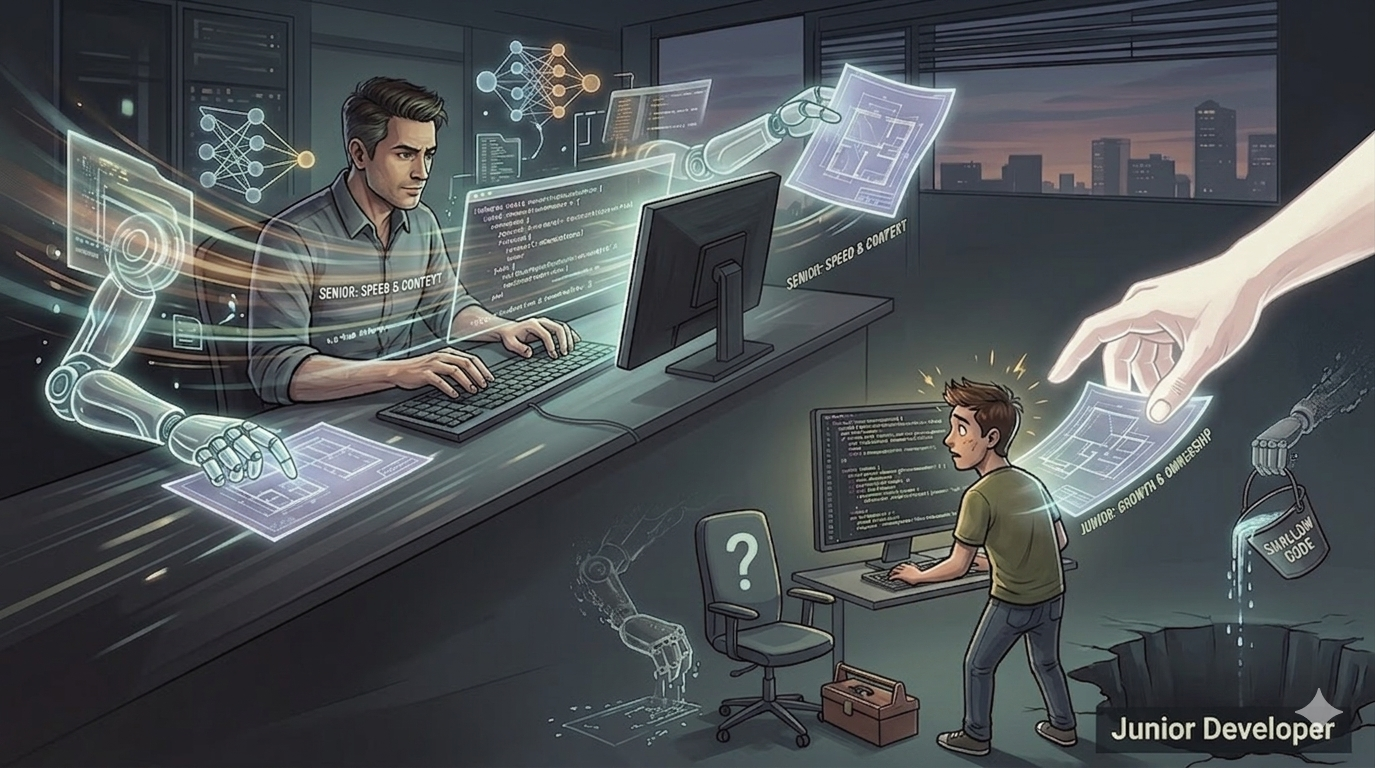
Over the past few year, I’ve watched senior engineers become dramatically faster. And I’ve watched junior engineers become dramatically shallower. Both things are happening at the same time. Both have the same cause: AI.
That’s not the narrative most people are running with. The narrative is simpler — entry-level roles are collapsing, bootcamp grads can’t find jobs, companies are quietly replacing junior headcount with AI tools and a couple of extra senior engineers. And the conclusion everyone keeps landing on is: the junior developer is going extinct.
I don’t buy it. Not entirely. I’ve spent over a decade building software and building teams — around 20 engineers at Gameskraft building Gamezy from scratch, about 15 at Zolve where fintech stakes made every architectural mistake expensive, and years mentoring developers through IBM boot camps and Pesto Tech. What I’ve seen consistently is this: the junior developers who struggled were never the ones who lacked potential. They were the ones who got handed tasks instead of problems. Instructions instead of context. Tickets instead of ownership. That was true long before AI arrived. AI has just made the cost of ignoring it a lot harder to hide.
The Real Question Nobody’s Asking
When a company says “we don’t need junior engineers anymore because AI handles the basics” — what they’re really saying is: we never had a real plan for growing them anyway.
Think about what a junior engineering role actually looks like in most organisations. Fix low-priority bugs. Write boilerplate. Implement features already specced to the last detail. Attend standups and listen. Wait. If that’s all your junior role ever was — a pair of hands for predictable, repeatable tasks — then yes, AI replaces it completely. And you should let it. But that was never what junior engineering was supposed to be.
What I Saw at IBM Changed My Mind Early
Between 2015 and 2017, I mentored developers at IBM boot camps — Bluemix, MobileFirst, cloud platforms that were genuinely new territory at the time. These weren’t engineers with five years of context behind them. These were people who had just started, building real things on infrastructure that barely had documentation.
One moment I keep coming back to: during a Bluemix session, a junior developer — barely six months into his first job — kept questioning why we were exposing a particular endpoint the way we were. Everyone else had accepted the design and moved on. She hadn’t. She kept pulling at it, politely and persistently, like something didn’t sit right with her.
She was right. The design assumed a request pattern that didn’t hold under concurrent load. Had we shipped it as-is, we’d have had a serious problem. A developer with no formal “experience” caught what experienced engineers had walked past — because nobody had told her yet that she wasn’t supposed to question it. That’s not a one-off. That’s what happens consistently when you give someone context instead of just instructions.
The junior developers who struggled weren’t the ones who lacked potential. They were the ones who got handed tasks instead of problems. Instructions instead of context. Tickets instead of ownership.
To Be Fair — Some of This Is Real
I want to be honest, because this argument gets one-sided too quickly.
Some organisations genuinely cannot justify large junior pipelines right now. A senior engineer with strong AI fluency can carry work that previously required two or three people. Timelines are shorter, budgets are tighter, and the economics of ramping someone who needs twelve months to become fully productive have changed. Pretending otherwise is naive.
If a team is consciously running smaller and more senior — with deliberate role design and real AI integration — that can be a legitimate strategy. The problem is when junior attrition is passive rather than a decision. When companies quietly stop backfilling junior roles while senior engineers silently absorb the load, that’s not a strategy. That’s a debt that’ll come due. And there’s a longer-term cost that doesn’t appear in any quarterly hiring report: the senior engineers of 2030 are junior engineers today. Stop growing them and you don’t just have a pipeline problem — you have an industry problem.
What AI Is Actually Doing to Junior Engineers
Here’s what I actually see on teams right now. Senior engineers are getting faster — genuinely faster. AI handles the scaffolding, boilerplate, and pattern-matching. A strong senior engineer uses that freed time to think harder about architecture, edge cases, and system design. Their output compounds.
Junior engineers are getting busier. AI generates code they can’t always evaluate. They ship faster, but they understand less. The feedback loop that used to exist — write something, watch it fail, have a senior engineer walk through the why with you — is shrinking, because there’s more output and less time for anyone to slow down and explain anything.
Here’s something concrete. AI can scaffold a REST API endpoint in under two minutes — authentication, validation, error handling included. What it won’t tell you is that your caching strategy will fall apart the moment 50,000 concurrent users hit that endpoint during a traffic spike. At Gameskraft, we built for exactly that scenario — live cricket match traffic could run 10 to 20 times the baseline. The judgment needed to design for that kind of load — where to cache aggressively, what to queue, where to fail gracefully — comes from having been burned before, or from a senior engineer who sat with you through a post-mortem and made sure you understood why it broke. AI can write the code. It cannot transfer that instinct.
The result is junior engineers who look productive but aren’t deepening. They’re skimming the surface faster. That’s not AI’s fault. That’s what happens when you hand a new driver a faster car without improving their judgment first.
The Uncomfortable Question
Here’s what I want to leave engineering leaders with. If junior roles are disappearing on your team, ask yourself honestly: were those roles ever designed for growth? Or were they designed for output?
Because if the answer is output — AI didn’t kill those roles. You built them to be killed. I’m not going to pretend I got this perfectly right at Gameskraft or Zolve either. Leading teams under real product pressure means optimising for output more than you’d like to admit. I’ve handed junior engineers tickets when I should’ve handed them problems. I’ve fixed things when I should’ve asked questions instead.
But here’s what the next five years make clear: the engineering leaders who build strong teams won’t be the ones who replaced junior engineers with AI. They’ll be the ones who finally used AI to free up senior engineers to do what they should’ve always been doing — mentoring, teaching, and giving junior developers real ownership of real systems early enough for it to matter. The best teams won’t be the biggest. They’ll be the ones where junior engineers own something, defend it, break it, and understand why — and where senior engineers finally have the time to make that happen.
Junior developers aren’t going extinct.
But the “give them the easy tickets and hope for the best” model of junior engineering? That one should have been extinct years ago.